
Why Choose a Female Android Smartwatch for Global Sourcing?
Why Choose a Female Android Smartwatch for Global Sourcing?
The Female Android Smartwatch market is moving beyond step counting. Buyers now expect health insights, elegant design, reliable connectivity, and practical daily comfort. A slim watch on a smaller wrist must still provide a readable display, responsive controls, and dependable battery life. These details influence returns more than attractive product photos.
Industry data supports this opportunity. IDC reported approximately 537.6 million wearable devices shipped worldwide in 2024, representing double-digit annual growth. Grand View Research also valued the global smartwatch market at more than US$30 billion in 2023. Its forecast points toward strong expansion through 2030. These figures include several wearable categories, not only women-focused products. That limitation matters. It reminds sourcing teams to avoid overstating market potential.
Jitesh Ubrani, Research Manager at IDC, has described wearables as “a diverse market with many different use cases and form factors.” His observation is highly relevant to the Female Android Smartwatch segment. Global buyers can compare case sizes, strap materials, localization, app compatibility, and after-sales support. Android compatibility also creates broader supplier options than closed operating systems. However, “Android compatible” does not guarantee a smooth user experience. Firmware quality, Bluetooth stability, health-sensor accuracy, and privacy controls require verification before large orders.
A practical sourcing review should inspect real samples. Test the watch beside a phone. Check charging after repeated use. Examine the strap after sweat and washing. Small weaknesses become expensive across thousands of units. The strongest supplier is not always the lowest bidder. It is the partner that documents performance, communicates limitations, and improves the product when testing exposes uncomfortable truths.
Definition and Core Features of Female Android Smartwatches
Why Choose a Female Android Smartwatch for Global Sourcing?
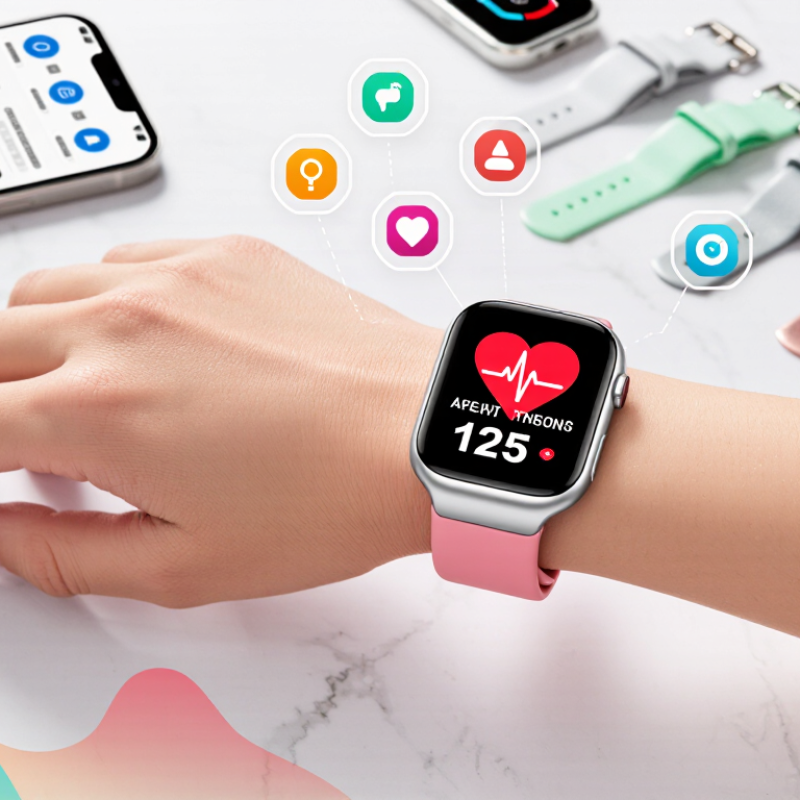
A female Android smartwatch is a wearable device designed around smaller wrists, daily styling, and Android phone compatibility. It usually combines health sensors, notifications, activity tracking, GPS, and wireless connectivity in a compact case. The “female” label can be useful for fit and design, but it may also oversimplify real users. Wrist sizes and preferences vary widely.
Core features should include heart-rate monitoring, sleep analysis, step counting, message alerts, and reliable Bluetooth pairing. Some models add menstrual-cycle tracking, blood-oxygen estimates, stress indicators, and emergency contacts. These functions support wellness decisions, not medical diagnosis. According to Grand View Research, the global smartwatch market is projected to grow strongly through 2030. Counterpoint Research also reported a 7% decline in global smartwatch shipments during 2024. This suggests that practical differentiation matters more than decorative design. Battery life, sensor accuracy, screen brightness, water resistance, and application compatibility deserve careful testing. A smaller case is not automatically better. It may sacrifice battery capacity.
Tips: Request samples in several case sizes. Test pairing with different Android versions. Check sensor consistency during walking and sleep. Review privacy controls before bulk sourcing. Avoid relying only on product specifications; hands-on testing often reveals charging problems, loose straps, or uncomfortable edges.
Why Choose a Female Android Smartwatch for Global Sourcing? - Definition and Core Features of Female Android Smartwatches
| Feature Dimension | Definition | Typical Technical Data | Global Sourcing Value |
|---|---|---|---|
| Product Positioning | A wearable smart device designed with a compact profile, practical health functions, and styling preferences commonly associated with female users. | Usually includes a smaller case, lighter construction, interchangeable straps, notification functions, and wellness monitoring. | Supports differentiated product positioning while serving customers who prefer comfortable, fashion-oriented wearable technology. |
| Android Compatibility | The ability to connect with Android smartphones through a dedicated mobile application and Bluetooth communication. | Commonly supports Android 8.0 or later, although the exact minimum version depends on the operating system and companion application. | Buyers should verify supported Android versions, application availability, pairing stability, notification access, and regional software restrictions. |
| Display | The screen used to show time, notifications, health information, menus, and watch faces. | Typical formats include 1.2–1.8-inch displays with resolutions of approximately 360 × 360 to 466 × 466 pixels. AMOLED offers strong contrast and deep black levels. | Screen size, brightness, touch sensitivity, and readability affect perceived quality, outdoor usability, packaging claims, and return rates. |
| Case Size and Weight | The physical dimensions and mass of the watch body, excluding or separately identifying the strap. | Compact models commonly measure about 36–44 mm across and weigh approximately 25–45 g without the strap. | Smaller and lighter designs can improve wrist comfort. Specifications should be reported accurately for product listings and size-sensitive customers. |
| Battery Capacity and Runtime | The stored electrical capacity and expected operating period between charges. | Many compact smartwatches use rechargeable lithium-polymer batteries in the approximate range of 200–400 mAh, with about 3–10 days of use depending on features and settings. | Runtime should be tested under defined conditions, including display brightness, Bluetooth use, health tracking, GPS use, and notification frequency. |
| Health Monitoring | Sensor-based tracking of selected wellness indicators for personal reference rather than medical diagnosis. | Common functions include heart-rate monitoring, blood-oxygen estimation, sleep tracking, step counting, calorie estimation, and menstrual-cycle recording. | Health-related claims require careful wording. Buyers should request validation information, data-privacy details, and regional regulatory guidance before marketing. |
| Sensors | Electronic components that detect movement, optical signals, orientation, or environmental conditions. | Frequently used components include an optical heart-rate sensor, accelerometer, gyroscope, and ambient-light sensor. Some models also include a barometer or geomagnetic sensor. | The sensor list helps compare functions, power consumption, tracking performance, and the level of software integration offered by different suppliers. |
| Sports and Activity Modes | Preconfigured software profiles that record activity data according to different exercise types. | Entry and mid-range products often offer approximately 20–100 activity modes, such as walking, running, cycling, swimming, yoga, and strength training. | The number of modes alone does not guarantee accuracy. Sourcing evaluations should focus on usable metrics, interface quality, and consistency of recorded data. |
| Location Tracking | The use of satellite positioning to record outdoor routes, distance, pace, or location. | Some watches provide built-in GNSS/GPS; others use the paired smartphone for location data. Built-in positioning generally increases power consumption and hardware cost. | This distinction should be clearly stated in specifications because independent GPS operation can significantly affect product value and customer expectations. |
| Water Resistance | The rated ability of the device to resist water exposure under specified test conditions. | Common ratings include IP67, IP68, or 5 ATM. IP ratings and ATM ratings are different systems and should not be treated as identical protection claims. | Suppliers should provide test documentation and clear usage limitations. Water resistance may be reduced by aging, impact, repairs, or chemical exposure. |
| Connectivity | The wireless methods used to communicate with smartphones, networks, accessories, or positioning systems. | Bluetooth Low Energy is standard for phone pairing. Some models additionally support Wi-Fi, NFC, or cellular connectivity, depending on the product configuration. | Connectivity influences compatibility, certification needs, battery life, regional availability, and the total landed cost of the product. |
| Communication Functions | Features that allow users to receive information or interact with a paired smartphone. | Typical functions include call and message notifications, calendar reminders, music controls, weather updates, alarms, and remote camera control. Calling requires a microphone and speaker. | Function availability can vary by Android version, application permissions, language, and phone manufacturer settings, so compatibility testing is essential. |
| Materials and Strap System | The materials used for the case, screen cover, buttons, and wristband, together with the method used to replace the strap. | Common choices include aluminum alloy or polymer cases, tempered glass or mineral glass, and silicone, fluoroelastomer, leather, or textile straps. Standard quick-release straps improve interchangeability. | Material selection affects durability, skin comfort, weight, appearance, cost, and the ability to offer seasonal or customized strap collections. |
| Charging System | The method used to replenish the internal rechargeable battery. | Magnetic two-pin or wireless charging cradles are common. Charging time is often approximately 1.5–3 hours, depending on battery capacity and charger output. | A complete sourcing review should include charger specifications, connector durability, replacement availability, electrical safety, and packaging configuration. |
| Languages and Localization | The languages supported by the watch interface, companion application, notifications, manuals, and packaging. | International products may support several major languages, but the supported list can differ between the device firmware and mobile application. | Localization reduces customer-service issues and supports multi-market distribution. Buyers should request language screenshots and conduct regional acceptance testing. |
| Privacy and Data Handling | The practices used to collect, store, transmit, and manage personal, health, and location-related information. | Relevant areas include account registration, cloud synchronization, permission controls, encryption, data deletion, and the location of data storage. | Privacy documentation and data-processing arrangements should be reviewed before selling in markets with applicable privacy or consumer-protection requirements. |
| Compliance and Documentation | The technical and legal documentation needed to place an electronic wearable product on a target market. | Depending on the destination, documentation may involve radio compliance, electromagnetic compatibility, battery transport information, chemical restrictions, user manuals, and recycling marks. | Complete documentation helps reduce customs delays, marketplace removals, warranty disputes, and compliance risks during global distribution. |
| Customization Potential | The extent to which the product can be adapted for a buyer’s target market without changing the core hardware platform. | Potential options include case colors, strap materials, watch-face designs, packaging, logo placement, manuals, firmware language, and application branding. | Customization can improve market fit, but buyers should confirm minimum order quantities, tooling charges, lead times, software ownership, and quality-control procedures. |
Note: Technical specifications are typical market ranges rather than guarantees. Final values should be confirmed through supplier datasheets, product samples, laboratory reports, and destination-market compliance checks.
